Android app
Field Geologist
Logs core, photographs it, takes samples and hands them over, at the rig or the core yard, with or without signal.
Core logging and sample traceability
A hole, a depth and a sample number are entered once at the rig. CoreChain carries them through logging, sampling, custody, the laboratory and QA/QC, so nobody re-types them at the next hand-off.
Read-only, built on Alberta Geological Survey open data.
In development testing. Not yet released.
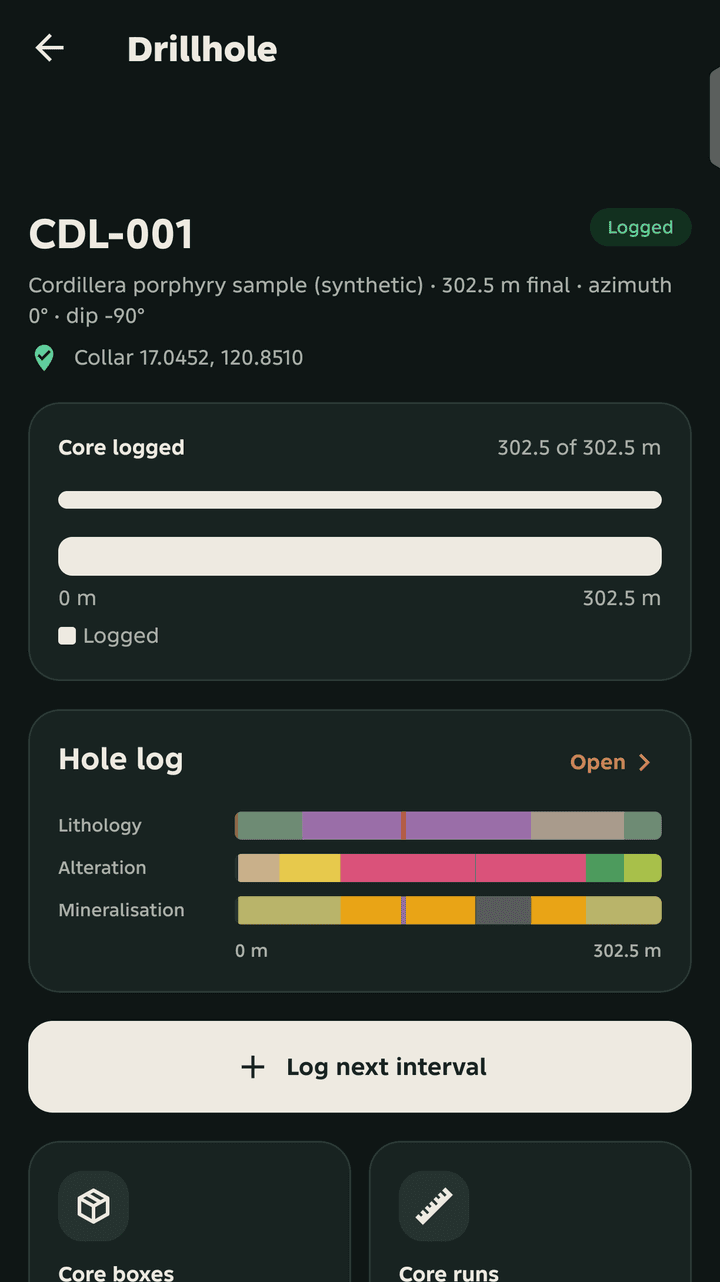
CDL-001
Cordillera porphyry sample (synthetic) · 302.5 m final
The same record on the web. Nothing re-typed.
Each step is recorded where the work happens and keeps what came before it. The laboratory result still knows its sample, depth and hole.
Hole, core boxes and runs, with recovery and RQD.
Depth intervals with the project's own code lists, and photos.
Numbers from the phone's own block or a tag book. QC inserted at the project's rate.
Every hand-over recorded and never edited, then dispatched to the laboratory.
Receives the batch, assays it and uploads the results against it.
Standards, blanks and duplicates judged against the results.
Reviewers for core and logging, and for sampling and custody, check steps 01 to 04 as they happen, not only at the end.
A team is the people around one drill rig. Each person works on the part that is theirs.
Android app
Logs core, photographs it, takes samples and hands them over, at the rig or the core yard, with or without signal.
Web
The Senior Geologist reviews logging, the Core Shed Supervisor sampling and custody, and the Database Geologist laboratory results.
Web
Receives dispatched samples by scan, then uploads the results file for the batch.
Web
Follows the team's holes, samples and activity, and keeps the code lists, standards and tags.
CoreChain Field · Android
CoreChain Field is built for a geologist working alone, in sun and gloves. Every screen that takes an entry shows something back.
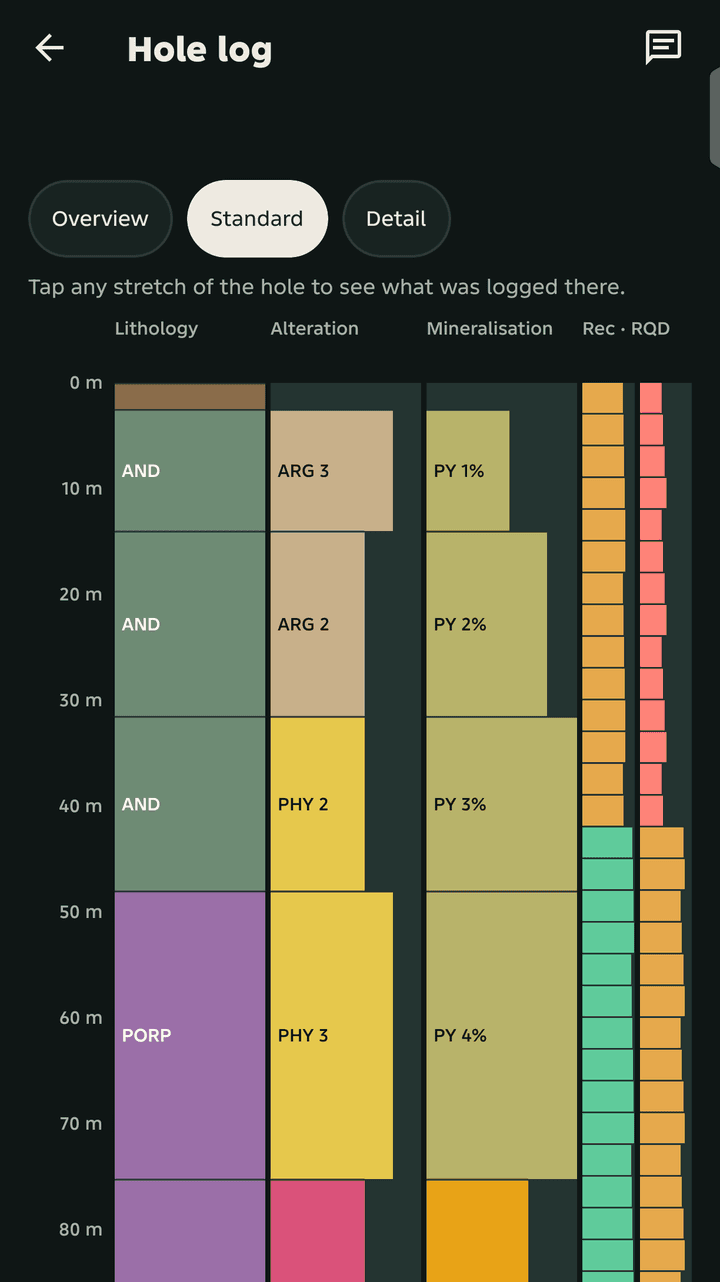
The hole as it is logged: rock, alteration, minerals, recovery and RQD against depth.
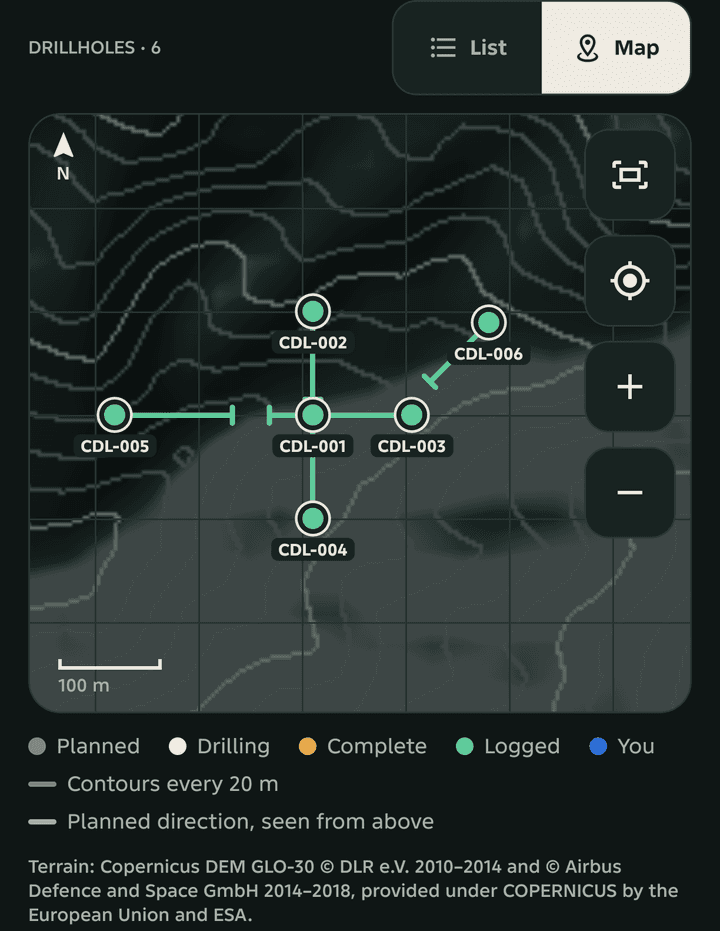
The project's holes on terrain, with their planned direction, and where you are standing.
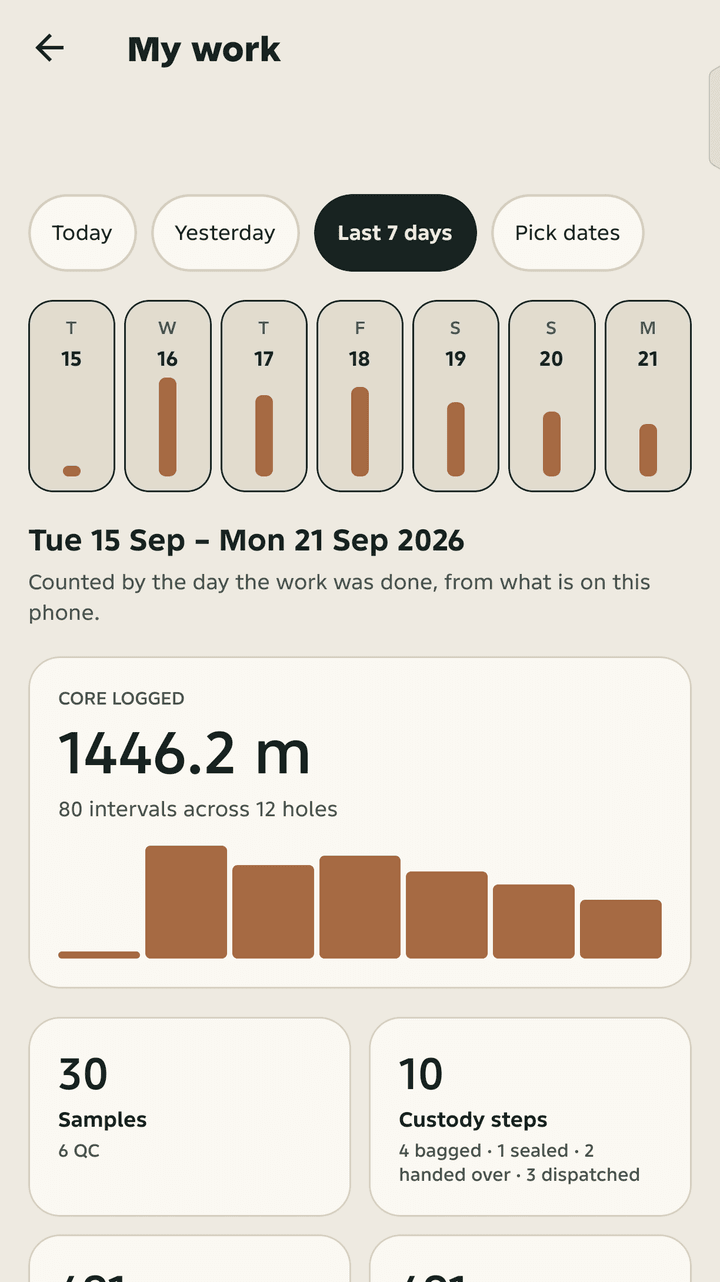
What was logged, sampled and handed over, by day, from what is on the phone.
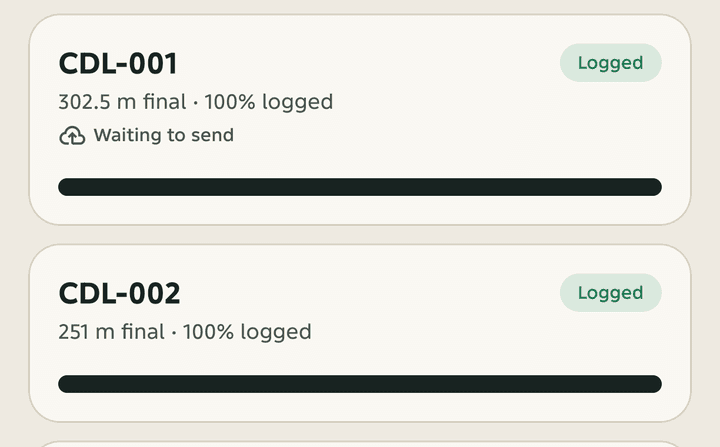
Everything is saved on the phone first, in an encrypted database. Records wait, marked as waiting to send, and go up when there is signal again. Conflicting changes are shown for a choice, never silently overwritten.
Large targets, light and dark themes, and known depths offered as one tap, so a depth already entered is never typed twice.
Each phone draws from its own block, or the geologist types the tag. A number is never issued twice or reused, even after a delete.
Traceability
Open any sample on the web and its whole record is there, joined up from the phone and the laboratory. Here is one from the laboratory demo project.
When the hole has been logged, the geology at that depth and the core photos are shown with the sample too. QA/QC decisions are kept on the reviewer's page.
LQC-00005
QC-DDH-01 · 12.0–13.5 m · Field duplicate
Custody and laboratory
The laboratory checks the batch in by scan, then uploads its results file. Problem rows are shown before anything is accepted.
DSP-QC-01-results-first-run.csv
7 results across 7 samples ready to import.
DSP-QC-01-results-reassay.csv
9 results across 9 samples ready to import.
QA/QC
Each reviewer owns one stage of the chain. CoreChain lays out the evidence; the reviewer decides to accept, hold or reject, with a note.
Gaps and overlaps between runs, recovery over 100%, and runs past the hole's final depth, while the hole is being worked.
QC inserted below the project's rate, overlapping samples, and custody that has stalled, before the results come back.
Standards, blanks and duplicates judged against the returned results.
QC-DDH-01
Laboratory QA/QC sample (synthetic) · first results file
Open exceptions
Warning beyond 2 SD. Fails beyond 3 SD, or on a second reading in a row beyond 2 SD on the same side.
Fails above the team's limit for that element.
Fails when the pair is more than 30% apart.
Missing results are flagged once the laboratory marks a batch complete, and results in the wrong unit are flagged too.
Records you can stand behind
CoreChain is structured around the records the Philippine Mineral Reporting Code (PMRC 2020) asks a company to be able to demonstrate: recovery, logging, sampling, QA/QC and chain of custody. It supports that work; it does not replace the judgement of your Accredited Competent Person.
When two people change the same record, the conflict is shown for a choice instead of one quietly replacing the other.
A mistake in a hand-over is corrected with a new step. The original stays on the record.
Each entry keeps who made it and when, and edits are versioned.
Records are kept on the phone until the server has them.
CoreChain is in development testing and has not been released yet. This is what works in testing today.
| Stage | Capability | Status |
|---|---|---|
| Field capture | Holes, boxes, runs, logging, photographs, samples and QC, export to CSV | Working in development testing |
| Accounts and backup | Sign-in, encrypted storage, and cloud backup and sync of records and photos | Working in development testing |
| Custody and dispatch | Recorded hand-overs, dispatch batches, and PDF or CSV dispatch sheets | Working in development testing |
| QA/QC review | Three review stages: core and logging, sampling and custody, laboratory assays | Working in development testing |
| Laboratory | Receive dispatched samples, upload results, and flag problem rows before they are accepted | Working in development testing |
| Manager dashboard | The team's holes, samples and activity, code lists, standards and tags | Working in development testing |
See a read-only sample project built on official open data from the Alberta Geological Survey.
Accounts are set up by us; there is no public sign-up. Tell us which of these fits, and we will reply.
Try the field app on your own time with made-up data and tell us what gets in the way. Geologists, mining people and software people are all welcome. A few geologists have already signed up.
Android phones only. We set up your account and send you the install link.
For an exploration or mining team that wants to see whether the workflow fits a real drilling programme.
We start with a conversation about your holes, your lab and how samples move today.
Already have an account? Sign in
Keep it connected all the way to the assay.